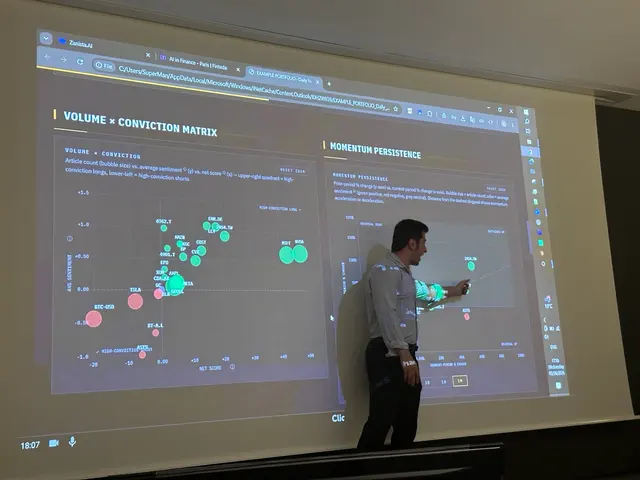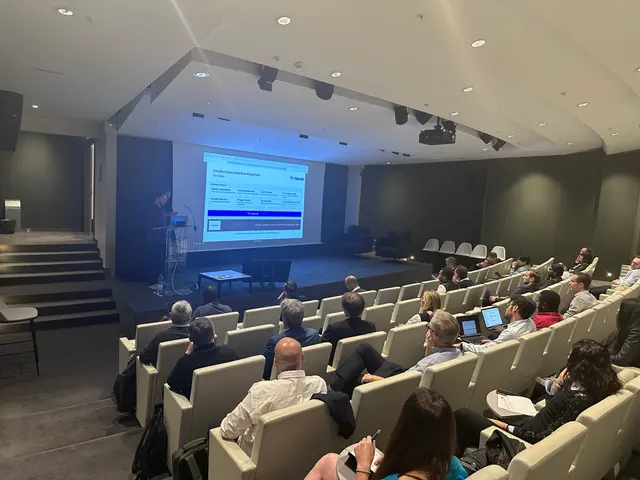
Aaron Stillwell presenting Neuralk's tabular AI platform to the audience at AI in Finance Paris

Event dossier · Paris · 3 June 2026

AI in Finance Paris

The production divide came into focus.

115held a place
91firms represented
23speakers
15sessions
22%buy-side

Applied AI is becoming less visible, and more consequential.

Across four industry talks, seven live demos, and two panels, the strongest through-line was not a model release. It was the movement of AI into the systems where financial work is already done: research, advice, portfolio construction, client intelligence, and risk.

This dossier is an editorial synthesis of the published programme and the verified event record. It separates what the source material supports from what would require a transcript or speaker-approved session recap.

What the programme made clear

01

AI earned its place inside the workflow.

The programme kept returning to the point where a model meets a real decision: inflation positioning, intraday signals, advisor preparation, portfolio construction, and investment research. The useful distinction was not AI versus no AI, but whether inference sat inside the operating loop or beside it as another screen.

02

Reliable context was the infrastructure debate.

A semantic client record, structured financial news, and production-grade web access all addressed the same constraint from different directions. Models are only as current, governed, and machine-readable as the information layer they can reach.

03

Reusable model layers are reaching tabular finance.

Neuralk and Databricks showed Seldon, a tabular foundation model designed to start from a strong pre-trained base rather than a bespoke model for every dataset. That changes the cost and speed calculation for financial teams with abundant tables and limited ML capacity.

04

Production readiness remained uneven by design.

The two panels compared shipped systems with proof-of-concept work across wealth management and agents. Regulation, confidentiality, controls, and human judgment were treated as architecture inputs, not as a compliance paragraph added after the demo.

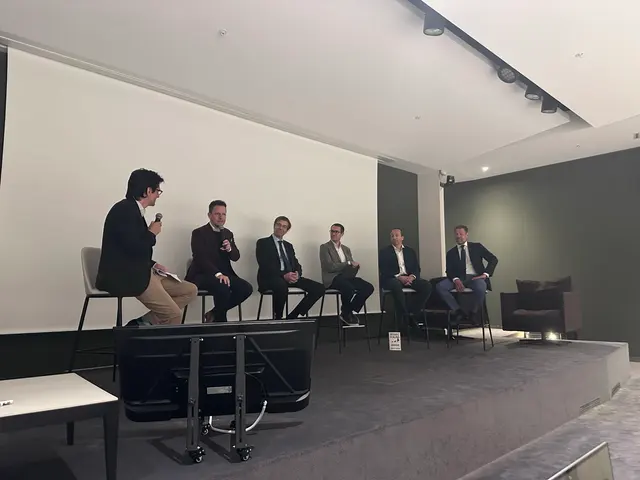
Wealth management panel on stage at AI in Finance Paris
Wealth Management x AI brought six operating-model perspectives onto one stage.

One afternoon, four connected systems

The sessions were deliberately mixed rather than split into separate quant, wealth, data, and agent tracks. Grouped after the fact, they reveal the stack the room was actually discussing.

01

Signals & research

  • Saeed Amen — forecasting and trading inflation with machine learning and alternative data
  • Alexandre Cesari — ML, macro data, and agents inside an entrepreneurial asset manager
  • Iordanis Kerenidis — temporal fusion transformers for futures microstructure
02

Advice & portfolios

  • Nicolas Obolensky — Harvest's view of the AI-enabled wealth advisor
  • Surender Uttamsingh — FactSet on advisor efficiency and client engagement
  • Stefan Klauser — AISOT inference inside the portfolio-construction loop
  • Wealth Management x AI — six operating-model perspectives, moderated by Friedhelm A. Schmitt
03

Data foundations

  • Aaron Stillwell & Laurent Fabre — Neuralk's Seldon tabular foundation model on Databricks
  • Till Blesik & Gregory Viet — semantic CBOR foundations for AI-ready client intelligence
  • Arman Khaledian — turning financial news into portfolio and risk signals
04

Agent infrastructure

  • Boris Toledano — real-time, structured web access for production agents
  • Bertrand K. Hassani — Virgo, a language model built for autonomous agents
  • AI Agents in Finance — bank, private-wealth, quant, and infrastructure perspectives, moderated by Hanane Dupouy
Practitioners speaking during the networking reception at AI in Finance Paris

Who was in the room

91 firms, without turning the room into a logo count.

The verified report describes 115 places held across 91 firms. Twenty-two percent of classified attendees came from the buy side, alongside banks, fintechs, data providers, researchers, and technology teams.

The public report shows the arithmetic, coverage limits, programme mix, partners, and curated gallery without exposing attendee names.

Open the verified report
The practical question is no longer whether finance will use AI. It is which decisions deserve automation, which data can support it, and where a human must still own the judgment.
A speaker presenting an AI conviction dashboard at AI in Finance Paris

Paris put those questions on the same programme rather than isolating them by product category. That made the dependencies visible: an agent needs current context; a model needs governed data; a workflow needs an accountable decision owner.

Follow the next AI in Finance edition